All articlesInside Genera
Inside the Genera AI Model Roster
Fifty-four faces on the same grey, numbered rather than named. What a casting book looks like when the models are AI.

Every model in the pictures below was cast, not found. They are shot against the same grey, lit the same way, framed the same way, and they are numbered — 0065, 0072, 0086 — rather than named. The format is an agency casting book, and the resemblance is deliberate.
Most tools in this category do not have a roster. They have a generator: you ask for “a woman, 25, brown hair”, and you get one, and you get a different one tomorrow. That is a fine way to make a picture and a bad way to run a catalogue.
A book, not a face filter
A roster is a fixed set of identities that exists before your brief does. Each one has been cast, shot in the same conditions as every other, given a number, and kept. You choose from it the way a casting director chooses from a book — by looking at a page of faces side by side under identical light, which is the only condition under which faces are actually comparable.
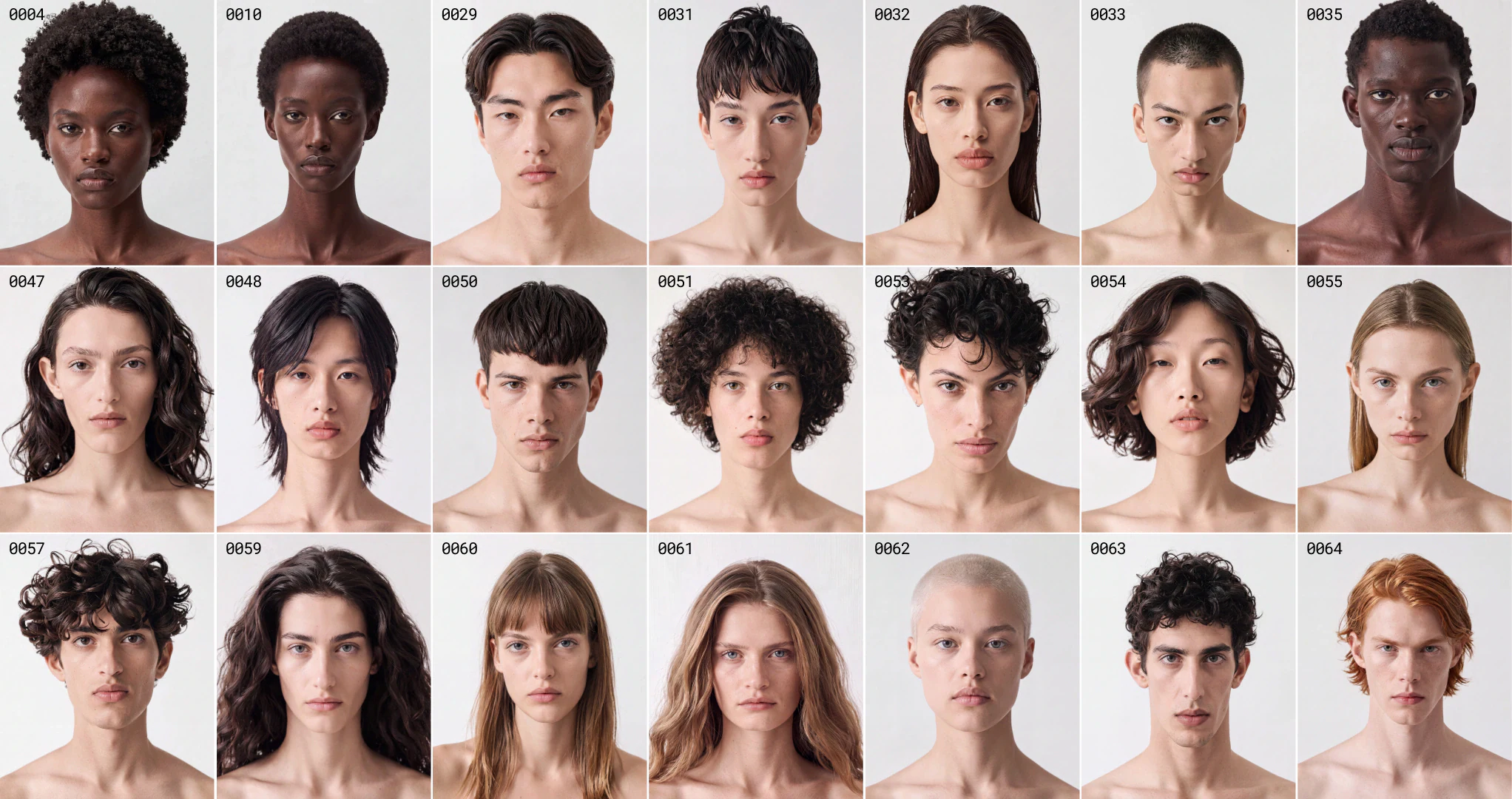
The practical consequence is that the model is a decision you make once. Everything that follows — the garment, the pose, the location, the beauty direction — moves around a fixed point. Without that fixed point, a 400-image catalogue is 400 slightly different people wearing your clothes.
What “unique” has to mean
The word is doing a lot of work in this category, so here is what we hold it to.
Not shared by accident. A roster identity is a specific, deliberate casting decision that lives in one book. It is not a stock face pulled from a pool that also feeds someone else’s generator, and it is not a real person’s likeness lifted without a contract.
Not drifting. Uniqueness that survives one image is a portrait. Uniqueness that survives a season is a model. The identity is saved and re-used, so image 400 has the same face as image 1 — same bone structure, same proportions, same skin.
Not legally vague. Every asset carries clear IP ownership and commercial usage rights, and the platform is built to GDPR and EU regulatory requirements. Where real fashion talent has been digitised, consent and revenue terms are documented rather than implied. If a supplier cannot tell you where a face came from, that is the answer to the question.
A face you cannot document is a face you cannot ship.
We wrote up the questions worth asking any vendor on this in Best AI Fashion Model Generators in 2026.
Cast for range, not for an average
The characteristic failure of generative casting is the average face: symmetrical, mid-twenties, mid-tone, unmemorable, and reproduced a thousand times with a different haircut. Every brief lands somewhere near the middle because the middle is where the data is densest.
A book is cast against that. The pages here carry vitiligo (0065), a mature model with a grey beard (0076), albinism (0086), five distinct red-hair tones, braided and close-cropped and long straight textures, and a spread of skin tones deep enough that the light had to be metered for each of them rather than once for the day.

This is a commercial decision before it is anything else. A brand selling into three regions needs models those regions recognise, and a brand whose customers are not all 24 needs a book that is not all 24 either. If your growth plan depends on a new market, the casting has to get there first — the situation we described in growing brands.
Why they are shot like passport photographs
The polaroids are deliberately plain: seamless grey, frontal, flat even light, shoulders bare, hair off the face, no styling, no expression to speak of.
Two reasons.
The first is comparison. Fourteen faces on a page can only be judged against each other if nothing else on the page is moving. Change the light or the crop between frames and you stop assessing the model and start assessing the photograph.
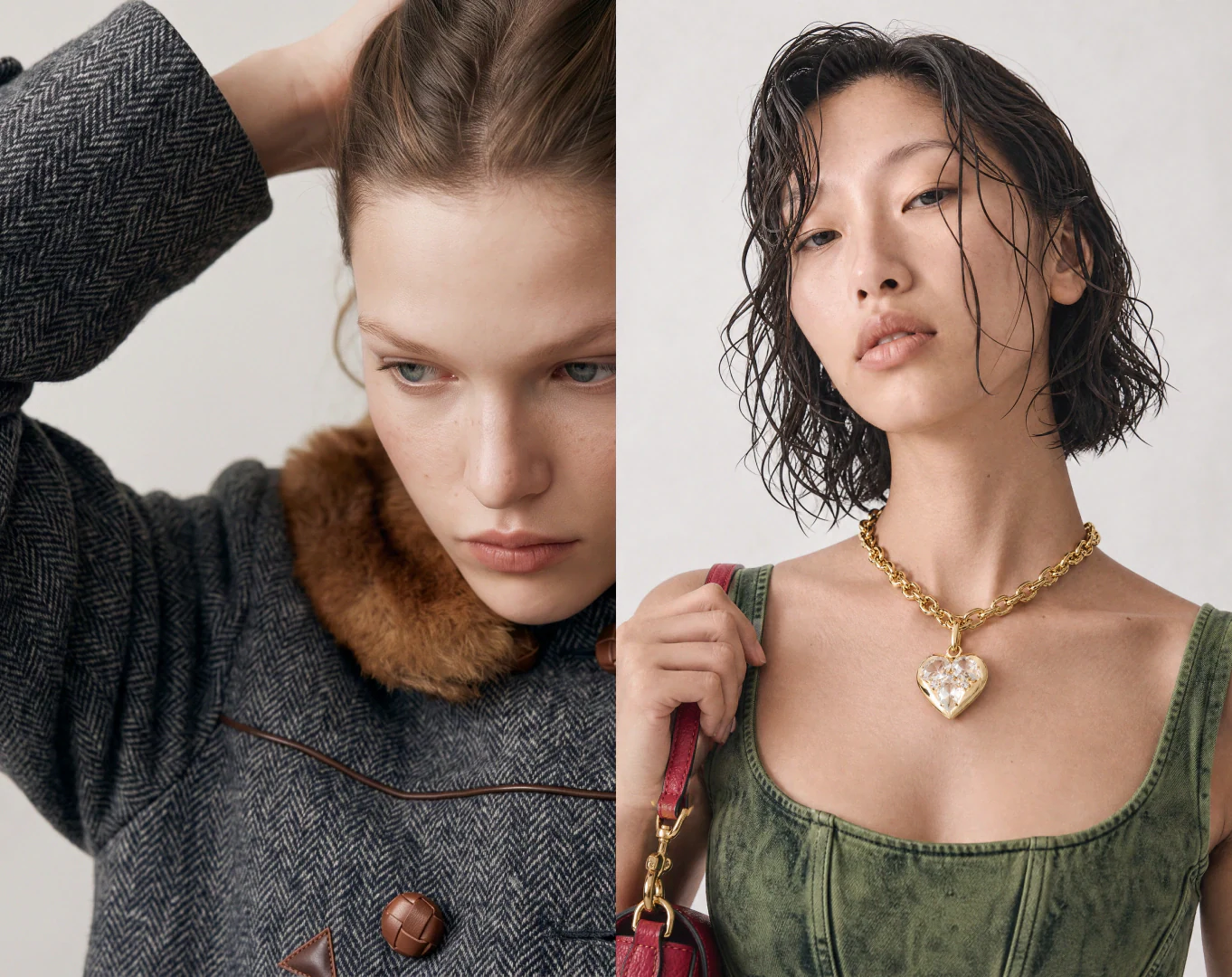
The second is that everything downstream is a variable. The garment is yours, replicated from your own references. The pose, the crop, the location and the beauty direction come from your brief. The polaroid is the one place in the pipeline where nothing has been decided yet, so it carries nothing to unlearn — no styling to fight, no colour cast to correct, no expression that only suits half a collection.
From a number to a catalogue
The route from the book to a live product page is short.
- Cast. Pick an identity from the roster, or brief a custom one — see below.
- Lock. The identity is saved and tied to the collection, so it is the same model next drop.
- Upload the garment. Flat lays, ghost mannequin shots, sample photos, or a tech pack if the sample does not exist yet. Clothing Replication reproduces the item — seams, stitching, print scale, hardware — rather than approximating it.
- Brief the picture. Poses, crops, lighting and location, from PDP standards to campaign.
- Review and publish. Approve and export.
A SKU comes out at up to $8 for four PDP images and one marketing image, production-ready in about twenty minutes, on plans that start at $29 a month; enterprise teams run up to 2,000 images a day. There is a working set of results on the gallery, and the whole pipeline is on the platform page.
When the book is not the answer
Sometimes the right face for a brand is not in the roster, and it should not be — a house with a strong casting identity does not want a model that anyone else can also book.
That is what Face Builder is for. You brief the demographics, the bone structure and the look the brand casts for, and the output is a new identity created for you and locked to your catalogue: unique in the strict sense, consistent across every drop, and carrying the same rights as anything else the platform produces. The AI fashion models page covers how that runs in practice.
Either way the principle is the same one the book is built on. Cast once, carefully, in conditions where you can actually see what you are casting — then let the clothes do the rest.
FAQ
02- How many AI fashion models does Genera have?
- The roster is a working casting book rather than a fixed catalogue — identities are added as they are cast. The pages reproduced in this article show 54 of them, numbered up to 0097. The current book is the one inside the platform.
- Can two different brands end up using the same AI model?
- A roster identity is available to anyone using the platform, which is why brands that want an exclusive face build one with Face Builder instead. A custom identity is created for that brand and locked to its catalogue.
- Can I keep the same model across a whole catalogue?
- Yes. An identity is saved and reused, so the face, the bone structure and the proportions hold across every SKU, scene and season — that consistency is the point of casting from a book rather than generating a new face per image.
- Are Genera's AI fashion models legal to use commercially?
- Yes. Every asset ships with clear IP ownership and commercial usage rights, and the platform is built to GDPR and EU regulatory requirements. Where real fashion talent has been digitised, consent and revenue terms are documented rather than implied.


